
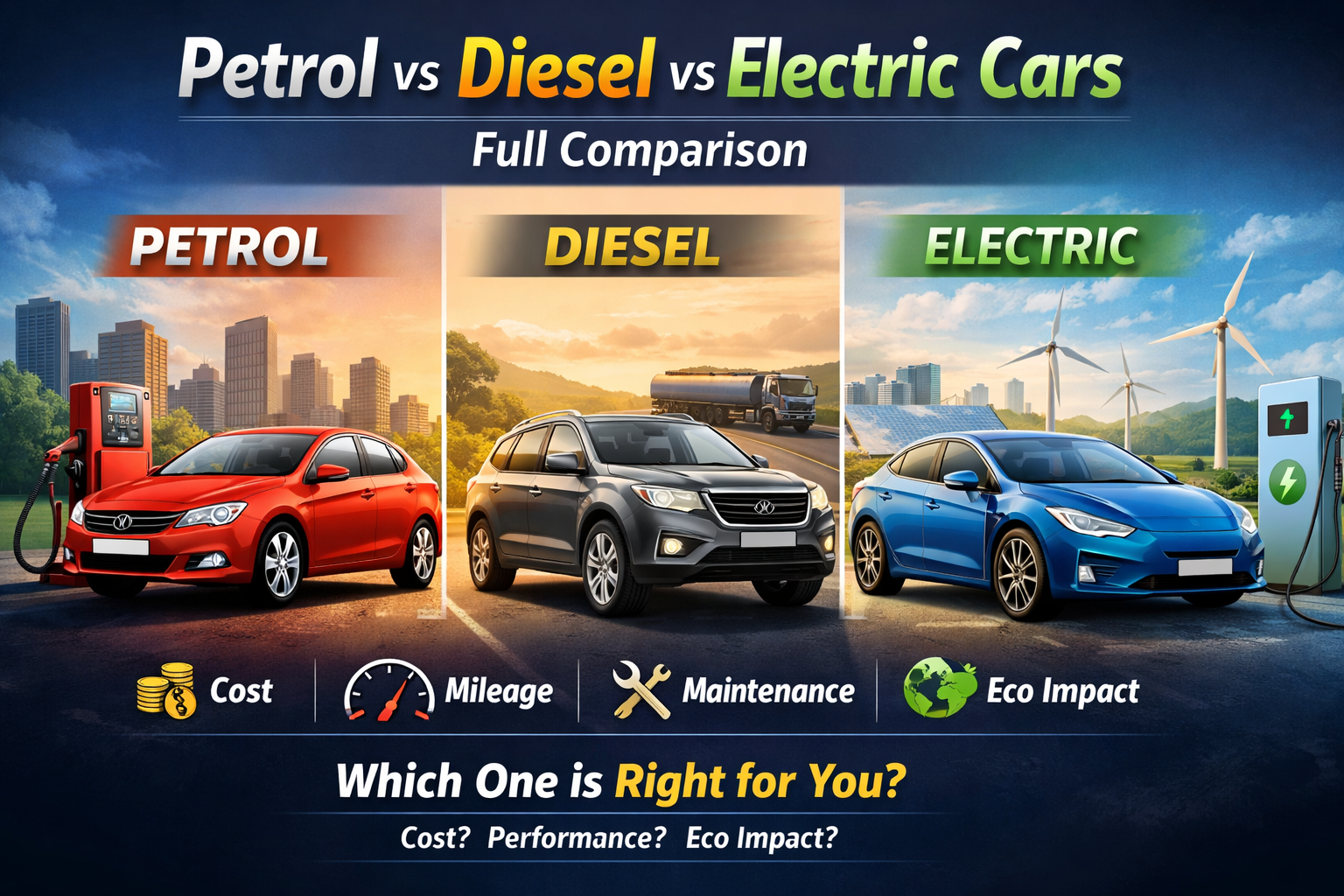
Petrol vs Diesel vs Electric Cars is still one of the most confusing decisions for car buyers in 2026, especially for first-time buyers. With fuel prices changing frequently, electric vehicle growth, and new government rules, choosing the right car is no longer as simple as it used to be. This guide gives a clear, beginner-friendly comparison of petrol, diesel, and electric cars based on cost, performance, maintenance, risks, and long-term value.
In simple words: petrol cars are affordable and smooth for city use, diesel cars suit long-distance and heavy usage, while electric cars promise low running costs and future readiness. However, there is no single “best” option for everyone – the right choice depends on how much you drive, where you live, and your budget. This detailed guide will help you compare all three so you can make a confident and practical decision.
Meaning / Explanation
Before comparing numbers and costs, it is important to understand what petrol, diesel, and electric cars actually are. Each uses a different technology to move the vehicle, which is why their behavior, costs, and maintenance are different.
Petrol Cars
Petrol cars use an internal combustion engine (ICE) that runs on petrol fuel. The fuel is mixed with air and ignited by spark plugs, which creates small controlled explosions that produce power. Because of this setup, petrol cars are known for smooth driving, quick throttle response, and lower engine noise. They usually have a lower purchase price than diesel or electric variants of the same model, and their maintenance is easier and more affordable for most local mechanics.
Diesel Cars
Diesel cars also use an internal combustion engine, but the working principle is slightly different. Instead of using spark plugs, diesel fuel ignites due to very high compression inside the cylinder, which generates heat and pressure. This design gives diesel engines higher torque at lower RPM, making them strong at pulling loads, climbing inclines, and cruising comfortably on highways. Because they burn fuel more efficiently, diesel cars usually deliver better mileage than petrol cars, especially for long-distance driving.
Electric Cars
Electric cars (EVs) do not have a traditional engine at all. They use one or more electric motors powered by electricity stored in a high-capacity battery pack. There are no exhaust gases, so they produce zero tailpipe emissions, which is why they are considered environmentally friendly at the point of use. EVs can be charged at home using a regular or dedicated charger, or at public charging stations installed in cities, malls, offices, and highways. They offer instant torque, quiet operation, and very low running cost per km compared to petrol or diesel cars.
Understanding these basic differences helps you see why fuel cost, maintenance needs, performance, and long-term ownership experience vary so much between petrol, diesel, and electric cars.
Why It Matters
Choosing between petrol, diesel, and electric cars is not just a technical choice – it directly affects your financial and ownership experience for many years. The fuel type you choose influences your:
- Total cost of ownership over 5–10 years
- Monthly running and fuel/charging expenses
- Maintenance and service frequency
- Environmental impact and emissions
- Resale value and future demand
Many buyers focus only on the ex-showroom price and regret their decision later. Hidden expenses like fuel, routine servicing, insurance, interest on car loans, and depreciation can easily add up to several lakhs over the car’s lifetime. To understand these often-ignored expenses in detail, you can read this guide on hidden costs of buying a car.
Your engine choice should always match your driving pattern. If you choose the wrong fuel type for your usage, you can end up paying much more in the long run, even if you saved some money at the time of purchase.
How It Works / Real-World Example
Let’s look at a simple real-world-style scenario to understand how petrol, diesel, and electric compare in practice.
Imagine three buyers, each driving around 1,200 km per month:
- City commuter: Mostly short daily rides in city traffic, frequent stop-go, low highway usage
- Highway user: Regular long-distance trips, more highway than city driving
- Urban tech enthusiast: Lives in a big city and has home parking with charging facility
For the city commuter, a petrol car usually works well because:
- The upfront price is lower than diesel or electric.
- The engine warms up quickly and handles stop-go traffic smoothly.
- Short trips do not justify the higher diesel car price.
For the highway user, a diesel car is often more sensible because:
- Diesel engines return better mileage on highways.
- Higher torque makes highway overtakes and hill climbs effortless.
- The higher initial cost can be recovered through fuel savings over high monthly kms.
For the urban tech enthusiast, an electric car can be a game changer:
- Charging at home is much cheaper than buying petrol or diesel.
- Most daily city runs fall well within the typical EV range.
- Instant torque, quiet cabin, and modern features add to the experience.
If you are also taking a car loan, EMI and interest cost make a big difference to your monthly outflow. You can estimate your total monthly burden including EMI using this car loan EMI calculator.
This example shows clearly that there is no universal “best” car. There is only the best car for your specific driving pattern, budget, and comfort with new technology.
Benefits
Benefits of Petrol Cars
- Lower purchase price: Petrol variants are usually cheaper than diesel and EV versions of the same model.
- Cheaper basic maintenance: Routine service and spare parts are usually affordable and easily available.
- Smooth and quiet driving: Petrol engines are refined and feel more relaxed in city speeds.
- Fuel availability: Petrol pumps are available almost everywhere, including smaller towns and rural areas.
- Ideal for city driving: Best suited for short trips, occasional highway use, and low to moderate annual mileage.
Benefits of Diesel Cars
- Higher mileage: Diesel engines deliver better km-per-litre, especially on highways and long drives.
- More torque and pulling power: Useful for SUVs, loaded vehicles, and hilly routes.
- Better fuel efficiency for long distances: Long trips become more economical when driven regularly.
- Longer engine life when maintained well: Diesel engines are generally built strong and can last high mileages.
Benefits of Electric Cars
- Very low running cost per km: Home charging usually costs far less than buying petrol or diesel.
- Minimal mechanical maintenance: No engine oil, clutch, or complex gearbox, which reduces servicing needs.
- Environment-friendly driving: Zero tailpipe emissions and lower overall emissions when electricity is cleaner.
- Instant torque and smooth acceleration: Electric motors deliver power immediately for a responsive feel.
- Government incentives in many regions: Tax benefits, reduced registration charges, and EV subsidies may be available.
If you want a focused discussion on whether EVs truly make sense in the coming years, read: Are electric cars worth it in 2026?
Risks / Limitations
Petrol Car Limitations
- Lower mileage: Petrol cars generally consume more fuel per km compared to diesel.
- Higher running cost: Petrol prices are usually higher and fluctuate frequently, increasing monthly expenses.
- Less suitable for heavy usage: For very high monthly mileage, running a petrol car can become expensive.
Diesel Car Limitations
- Higher initial cost: Diesel variants usually cost significantly more than petrol variants.
- Expensive maintenance: Components like injectors, turbos, and filters can be costly to repair or replace.
- Stricter emission norms: Many cities are becoming less friendly to diesel with tighter regulations.
- Not ideal for short city trips: Frequent short runs may cause issues like clogged DPF (in modern diesels).
Electric Car Limitations
- High upfront cost: Battery packs make EVs more expensive to purchase initially.
- Limited charging infrastructure in some areas: Smaller towns and rural regions may still lack enough chargers.
- Range anxiety: Worry about running out of charge during long or unplanned trips.
- Battery replacement cost: Over very long-term use, replacing the battery can be a major expense.
- Long charging times: Even with fast charging, it takes longer to recharge than refueling petrol or diesel.
Being aware of these limitations helps you set realistic expectations and avoid expensive surprises after buying.
Cost and Usage Comparison (Overview)
Here is a simple overview-style comparison to quickly understand how the three options differ in day-to-day use:
| Aspect | Petrol | Diesel | Electric |
|---|---|---|---|
| Initial Price | Lowest among the three for most models | Higher than petrol | Highest due to battery cost |
| Fuel / Energy Cost per km | High | Medium | Very low |
| Best Usage Type | City and low-moderate usage | Highway and heavy usage | City and fixed daily routes |
| Maintenance Complexity | Simple | Moderate to complex | Low (few moving parts) |
| Environmental Impact | Higher emissions | Higher NOx/particulate emissions | Zero tailpipe emissions |
Common Mistakes / Myths
- Myth: Diesel is always cheaper – Reality: It is cheaper only if you drive high monthly kilometres and recover the higher purchase cost through fuel savings.
- Myth: Electric cars have zero cost – Reality: You still pay for electricity, battery ageing, and sometimes higher insurance.
- Myth: Petrol cars are outdated – Reality: Petrol is still the most practical option for many city and low-mileage users.
- Mistake: Ignoring resale value – Future regulations and demand patterns strongly affect how much you can sell your car for later.
- Mistake: Not considering future regulations – Some cities may restrict or penalise older diesel vehicles or high-emission models in coming years.
Another frequent mistake is choosing a brand new car without comparing used car options. Many buyers can save significantly or move to a higher segment by choosing a good pre-owned car. This comparison can help: New car vs used car – which is better?
For a data-driven cost comparison of EVs, petrol, and diesel cars in India, you can also refer to this detailed ownership cost study by Spinny: EVs vs Petrol vs Diesel – Cost of Ownership.
To understand current government incentives for electric vehicles in India, including FAME-II and other schemes, visit the official e-AMRIT portal: Electric Vehicle Incentives – e-AMRIT.
If you are a first-time buyer and want a broader comparison that also includes CNG and hybrid options, you may find this guide useful: Petrol vs Diesel vs CNG vs EV vs Hybrid: Which Car Should You Buy?.
FAQ Section
1. Which is cheaper to maintain: petrol, diesel, or electric?
Electric cars generally have the lowest maintenance because they have fewer moving parts and no engine oil, followed by petrol cars, with diesel cars usually having the highest upkeep costs.
2. Are electric cars suitable for long trips?
Electric cars can be used for long trips if there is enough charging infrastructure on your route and you plan your stops in advance. For unplanned long drives in remote areas, petrol or diesel may still be more convenient.
3. Is diesel still worth buying?
Diesel is still worth buying if you regularly drive long distances or have high monthly mileage, because the better fuel efficiency can offset the higher purchase and maintenance costs over time.
4. Which car type has the best resale value?
Diesel cars often retain value better in markets where commercial and high-usage buyers are active, but in some cities, changing regulations may reduce diesel resale demand. Good petrol models also hold steady resale in urban markets.
5. Are petrol cars future-proof?
Petrol cars are likely to remain relevant for many years, especially in cities and regions where EV charging is still developing, though stricter emission norms can gradually push buyers toward cleaner alternatives.
6. How long do electric car batteries last?
Most modern EV batteries are designed to last around 8–10 years depending on usage, climate, and charging habits, after which they may still work but with reduced range.
7. Which is best for beginners?
Petrol cars are usually the safest and simplest option for beginners because they are affordable, easy to drive, and widely supported by service centres and mechanics.
How to Decide the Best Option for You
To choose the right fuel type, ask yourself a few key questions:
- How many kilometres do you drive per month on average?
- Is your driving mostly city, mostly highway, or mixed?
- Do you have a dedicated parking space where you can install an EV charger?
- How long do you plan to keep the car – a few years or more than 7–8 years?
- Are there any upcoming restrictions on diesel or older vehicles in your city?
In general:
- If your running is low (under ~800–1,000 km/month), a petrol car is usually the most sensible and budget-friendly choice.
- If your running is very high (above ~1,500 km/month) and you often drive on highways, a diesel may still be worth it.
- If you have home charging access and plan to keep the car for many years, an electric car can offer big savings on running costs.
Conclusion
The debate of petrol vs diesel vs electric cars does not have a single permanent winner. Each option has its own strengths and is designed to serve a different type of user and driving pattern. Petrol cars are affordable, beginner-friendly, and ideal for city and low-mileage users; diesel cars excel in long-distance and heavy usage; and electric cars represent the future with low running costs and clean driving.
Your decision should be based on your driving habits, monthly mileage, budget, comfort with charging, and long-term plans. If you match the right car type to your real usage, any of these options can turn into a smart, satisfying investment instead of a financial burden.
Disclaimer: This article is published for informational and educational purposes only. The comparisons, examples, and cost estimates related to petrol, diesel, and electric cars are based on general market trends and publicly available information at the time of writing. Vehicle prices, fuel costs, charging expenses, government policies, incentives, and regulations may vary by location and change over time. This content should not be considered financial, legal, or professional automotive advice. Readers are advised to independently verify details and consult authorized dealers, manufacturers, or qualified professionals before making any vehicle purchase decisions.