
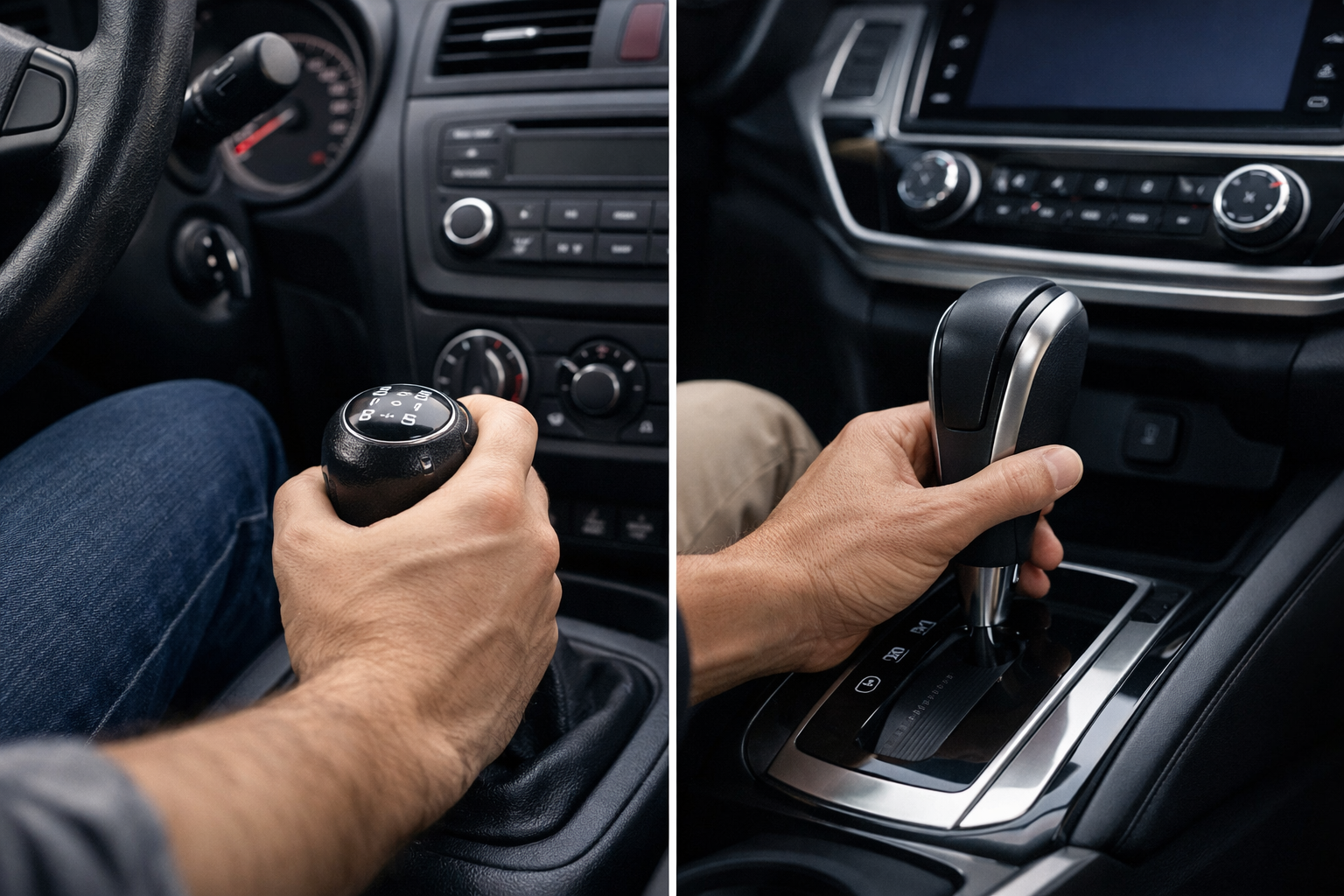
Manual vs Automatic Cars: Automatic vs Manual Transmission
Manual vs automatic cars is one of the most common questions among new car buyers, especially beginners. If you’re confused about automatic vs manual transmission, you’re not alone. Both systems do the same basic job—helping your car move—but they work in different ways and suit different driving styles.
In simple terms, manual cars require the driver to change gears using a clutch and gear lever, while automatic cars handle gear changes on their own. This beginner-friendly guide explains everything you need to know so you can choose the right transmission with confidence. Whether you’re stuck in urban gridlock or cruising on open highways, understanding these differences can save you time, money, and frustration.
Globally, the automotive market is shifting: automatics now dominate sales in many regions, while manuals retain popularity in performance segments and cost-conscious markets. With electric vehicles becoming more common, transmissions are evolving too—but the basic choice between manual and automatic is still highly relevant for most buyers.
Meaning / Explanation
A car transmission is the system that transfers power from the engine to the wheels. The debate of manual vs automatic cars comes down to how this power transfer is controlled. The engine produces power, but the transmission decides how that power reaches the wheels efficiently at different speeds.
Manual transmission requires the driver to press a clutch pedal and manually select gears using a gear stick. The driver decides when to change gears based on speed, engine sound, and driving conditions. Most manual cars have 5 or 6 forward gears plus reverse. The clutch acts as a temporary disconnect between the engine and gearbox, allowing the driver to shift gears without damaging components. This hands-on approach gives drivers a direct “feel” for the car’s behavior.
Automatic transmission, on the other hand, changes gears automatically without driver input. Modern automatics use technologies such as torque converters, CVTs (Continuously Variable Transmissions), or dual-clutch systems (DCTs) to optimize performance and comfort. A torque converter uses fluid coupling to enable smooth starts, CVTs provide seamless acceleration without fixed gear steps, and DCTs use two clutches to shift faster than a human can. To the driver, it feels simple: select “D” (Drive), and the car does the rest.
Why It Matters
Choosing between automatic vs manual transmission matters because it affects driving comfort, fuel efficiency, learning curve, maintenance cost, and long-term ownership experience. In congested cities, the wrong choice can make daily commuting stressful, while on highways it can affect enjoyment and performance.
For drivers who deal with frequent stop-and-go traffic, automatic cars significantly reduce stress and fatigue. Instead of constantly pressing the clutch and shifting, the driver can simply accelerate and brake. For enthusiasts or drivers on a tighter budget, manual cars often provide better control, a more engaging feel, and a lower purchase price.
Your choice also impacts long-term factors such as:
- Fuel costs over years of ownership.
- Repair and maintenance expenses.
- Resale value in your region or market.
- Ease of teaching or learning driving for family members.
How It Works / Example
In a manual car, the driver is in charge of choosing gears. When the car starts moving, the driver presses the clutch, selects first gear, and gently releases the clutch while pressing the accelerator. As speed increases, the driver shifts to higher gears to reduce engine strain and improve efficiency. For example, while overtaking on a highway, the driver might downshift from 5th to 3rd gear to increase engine power and accelerate quickly.
In an automatic car, sensors and onboard computers handle these decisions. The transmission controller constantly monitors speed, throttle position, and load. When the driver presses the accelerator harder, the system downshifts automatically to provide more power for overtaking. When cruising at steady speed, it shifts to higher gears for better fuel economy. The driver usually only selects modes such as P (Park), R (Reverse), N (Neutral), and D (Drive).
This automation makes driving easier, especially for beginners or people who drive in crowded urban environments. It reduces the chance of stalling, rolling back on hills, or selecting the wrong gear. Many modern automatics also offer “manual mode” with paddle shifters, letting drivers enjoy more control when they want it.
Benefits
Benefits of Manual Cars
- Lower purchase price compared to automatic variants of the same model.
- Better direct control over the vehicle, especially on winding roads or in performance driving.
- Generally lower maintenance costs because the mechanism is simpler and has fewer complex electronic parts.
- Historically higher fuel efficiency in older models or basic cars without advanced automatic systems.
- Preferred by many driving enthusiasts who enjoy the engagement of shifting gears themselves.
- Often lighter in weight than automatic versions, which can benefit handling and responsiveness.
Benefits of Automatic Cars
- Very easy to drive, especially for beginners and those who feel nervous about coordinating clutch and gears.
- Ideal for heavy city traffic, where frequent stopping and starting would make manual driving tiring.
- Less driver fatigue on long commutes or in congested conditions.
- Smoother driving experience with seamless or near-seamless gear changes.
- Modern automatics often match or exceed manual fuel efficiency, especially with CVT and advanced multi-speed gearboxes.
- Available with advanced features like paddle shifters, drive modes (Eco, Sport), and adaptive cruise control in many modern cars.
Risks / Limitations
Manual Transmission Limitations
- Steeper learning curve for new drivers; it takes time to master clutch control and smooth gear changes.
- Tiring to drive in stop-and-go traffic where constant clutch use is required.
- Clutch wear over time; improper driving habits (like riding the clutch) can lead to earlier and more expensive clutch replacements.
- More effort required on steep hills, in heavy rain, or on slippery surfaces, especially for inexperienced drivers.
Automatic Transmission Limitations
- Higher initial cost compared to equivalent manual models.
- Potentially more expensive repairs if the transmission or electronic components fail.
- Some drivers feel less direct control, which can be a drawback for performance-oriented driving.
- Older or basic automatic designs may feel slower to respond or less engaging than manuals.
- Can be heavier and more complex, which may slightly increase long-term maintenance complexity.
Common Mistakes / Myths
- Myth: Automatic cars are always less fuel-efficient.
Reality: Many modern automatics are highly efficient and can match or even outperform manuals in real-world driving, especially in city conditions. - Myth: Manual cars are outdated and disappearing.
Reality: Manuals are still popular in certain regions and among enthusiasts, budget buyers, and drivers who value control. - Mistake: Choosing a manual only to save money without considering daily driving conditions like traffic, hills, and commute length.
- Mistake: Assuming automatics require no maintenance. In reality, transmission fluid changes and proper servicing are essential to avoid costly repairs.
- Myth: All automatics are slow and “lazy.”
Reality: Modern dual-clutch and multi-speed automatics can shift faster than most human drivers and offer excellent performance. - Mistake: Not test-driving both types before deciding. A short drive in real traffic can completely change your preference.
External Resources
FAQ Section
1. Which is better: manual vs automatic cars?
It depends on your needs and driving style. Automatic is generally better for convenience and comfort, especially in traffic. Manual is better if you prioritize control, engagement, and often a lower purchase price.
2. Is automatic transmission good for beginners?
Yes. Automatic cars are easier for beginners because there is no clutch pedal or manual gear shifting. New drivers can focus more on steering, braking, and road awareness.
3. Do manual cars give better mileage?
Older cars often had better fuel economy with manuals. However, many modern automatics, especially CVTs and advanced multi-speed gearboxes, offer equal or better fuel efficiency in everyday use.
4. Are automatic cars expensive to maintain?
They can be more expensive if major transmission repairs are needed, because automatic systems are more complex. Regular fluid changes and servicing, however, can greatly reduce the risk of big repair bills.
5. Is manual transmission safer?
Safety depends more on the driver’s behavior, attention, and skill than on the transmission type. Both manual and automatic cars can be safe if driven responsibly and equipped with modern safety features.
6. Can automatic cars be used for long drives?
Yes. Automatic cars are excellent for long-distance driving, especially on highways, because they reduce fatigue and can work well with features like cruise control.
7. Do automatic cars have gears?
Yes. Most automatic cars still have multiple gears, but the gear changes happen automatically. CVTs are a bit different, using a system of pulleys to provide continuously variable ratios instead of fixed gears.
8. Which transmission has better resale value?
This varies by region. In markets where automatics are more popular, automatic cars often have stronger resale demand. In areas where manuals are common, well-maintained manual cars can also hold value well.
9. Can I convert a manual car to automatic?
Technically it is sometimes possible, but it is usually very costly and complicated. It often affects reliability and resale value. It is almost always better to buy a car that originally comes with the transmission type you want.
10. How do electric vehicles affect this debate?
Most electric vehicles (EVs) use a single-speed transmission or a very simple reduction gear, so there is no traditional manual vs automatic choice. However, understanding manuals and automatics is still important for conventional petrol and diesel cars, which will remain common for some time.
Related Reading
- New Car vs Used Car: Which Is Better?
- Petrol vs Diesel vs Electric Cars
- Sedan vs SUV: Which Should You Buy?
Conclusion
The choice between manual vs automatic cars ultimately comes down to your driving habits, budget, and comfort preferences. Automatic vs manual transmission is not about which is universally better, but which is better for you personally. If you value ease and convenience, an automatic is usually the better choice. If you enjoy control, engagement, and a more connected driving experience, a manual may suit you more.
Understanding these differences helps you make a confident, informed decision that matches your lifestyle, local traffic conditions, and long-term ownership plans. Always test-drive both options and consider how and where you drive most often before deciding.
Disclaimer
This article is for informational purposes only and does not constitute professional automotive, financial, or mechanical advice. Specifications, costs, and performance may vary by manufacturer, model, and region. Always consult authorized dealers or certified professionals before making a vehicle purchase decision.
Pingback: Hatchback vs Compact SUV: Ultimate Small SUV 2026 Comparison Guide